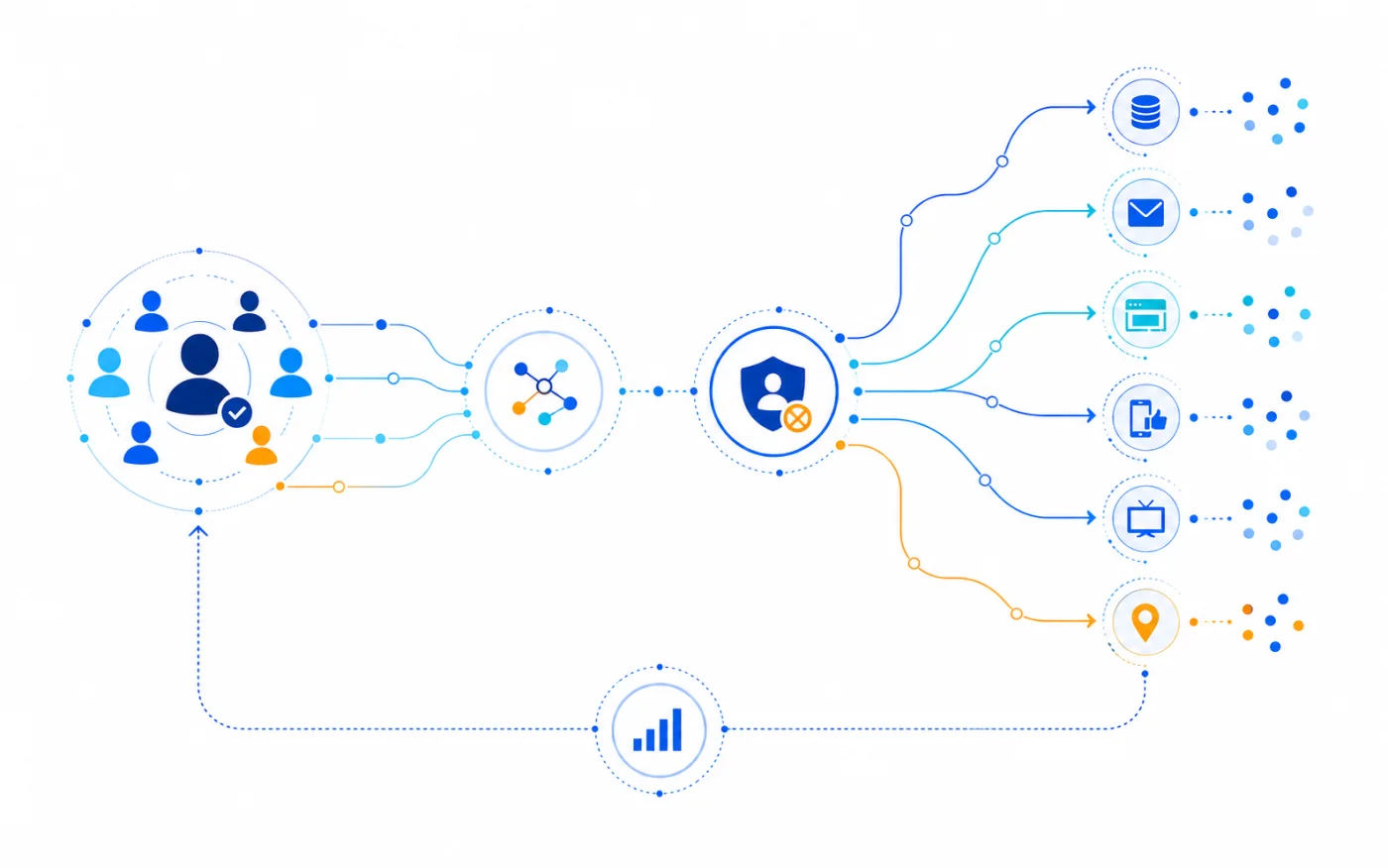
Start with one governed audience definition
Cross-channel activation fails when every system uses a different definition of the person, their stage, and the action they need. Begin with a source audience that includes eligibility, exclusion, entry, and exit criteria.
A practical audience record should explain who the person is, why they qualify, when the signal occurred, which topics are relevant, what channels are permitted, and when they should leave the audience.
Give every channel a specific role
CRM
Use CRM for high-confidence, high-fit people who need human follow-up. Route only the context a seller needs: identity, account, signal reason, relevant topic, and recommended action.
Lifecycle and marketing automation
Use lifecycle programs for known people who need education, proof, or timing. Adapt the content path to the topic and maturity of their research.
Paid media
Use media to maintain message continuity, reinforce a decision theme, or reach known audiences where direct outreach is not appropriate. Keep suppression lists synchronized.
One-to-one and location-aware marketing
Use location or individual activation when a real-world visit or local opportunity meaningfully changes the next best action. Apply tighter relevance and permission rules because the experience is more personal.
Orchestrate action, not simultaneous noise
Cross-channel does not mean every channel at once. Build a priority order and conflict rules. A newly assigned sales task may pause lifecycle messaging. A converted customer should leave prospecting audiences quickly. A stale intent signal should decay without manual cleanup.
- Set the primary action for each audience tier.
- Define supporting channels and delays.
- Apply frequency, suppression, and ownership rules.
- Write explicit exit conditions.
- Monitor delivery and destination acceptance.
Use a small state model such as observed, qualified, activated, engaged, progressed, and exited. Every channel should read and update that shared state where possible.
Close the loop around progression
Channel metrics alone do not show whether orchestration is working. Measure whether qualified identities reach the right destination, receive the intended action, and progress through the journey.
- Delivery: audience match and destination acceptance.
- Execution: time to action and workflow completion.
- Engagement: relevant response across coordinated channels.
- Progression: movement to the next meaningful stage.
- Suppression quality: timely removal after conversion or disqualification.
The feedback should improve the audience definition itself. Over time, accepted and rejected actions provide evidence for better fit, intent, timing, and channel rules.